Dietary Fats & Hormones
By. Ysanne Griffin
If you grew up hearing that fat makes you fat, you’re not alone. For years, dietary fat was painted as the villain behind heart disease. But research has flipped that old story on its head, we now know that fat is essential for hormone health, brain function and overall wellbeing.
In fact, the right kinds of fat help your body make hormones like estrogen, progesterone and testosterone (the chemical messengers that keep everything from your mood to your metabolism in check.)
Let’s break down how different fats affect your hormones (for both men and women), where to find healthy fats and what the science actually says.
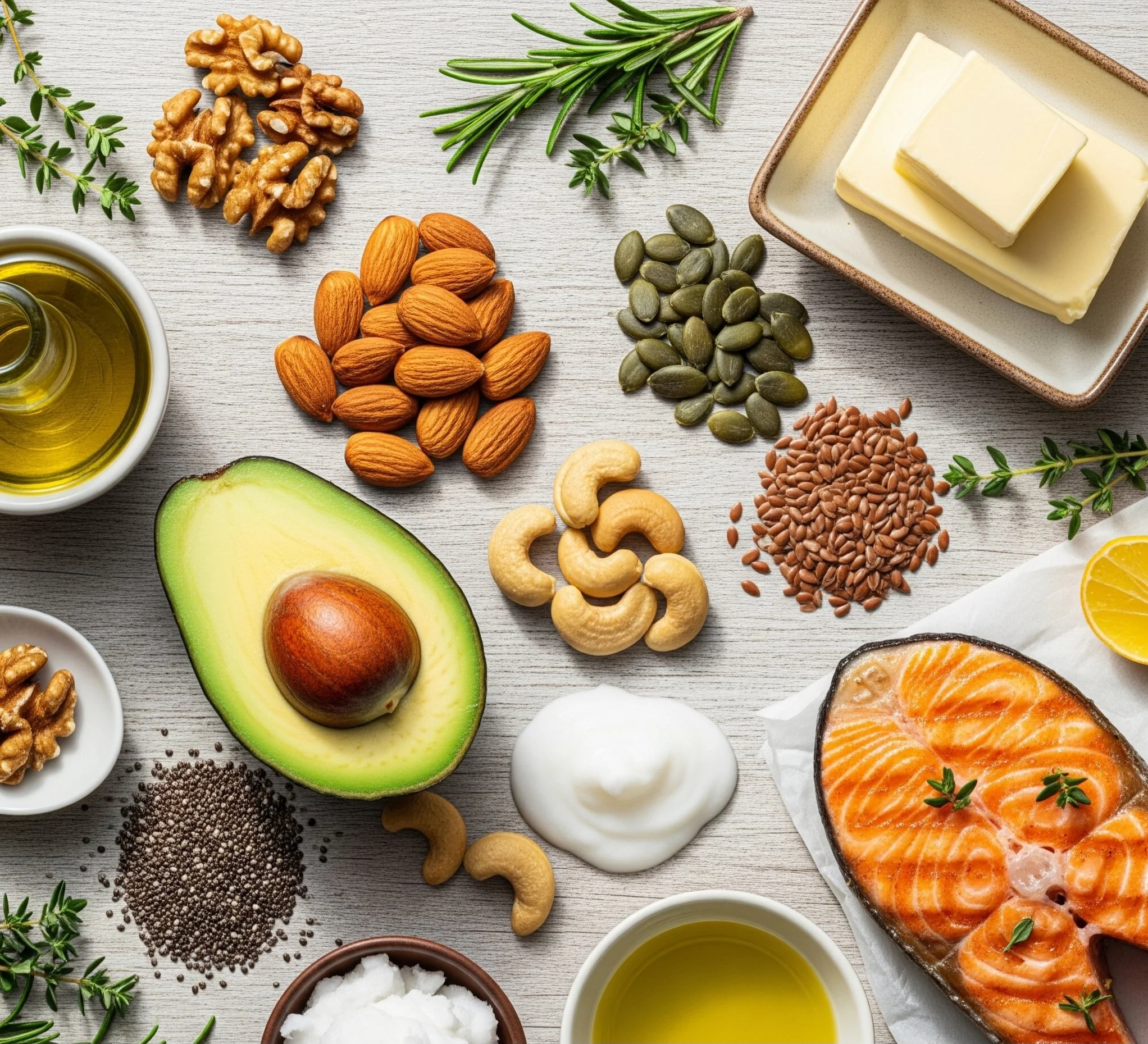
Healthy Fat 101: What to Eat More Of
Not all fats are created equal. Think of them as a spectrum, hero fats to troublemakers.
The hero fats:
Monounsaturated Fats: Found in olive oil, avocados and nuts. These fats are heart friendly and may even help with insulin sensitivity [7].
Omega-3 Fats: Found in salmon, mackerel, chia seeds, flaxseeds and walnuts. They help reduce inflammation and may support hormone balance [7].
Whole Food Fats: Getting your fats from real foods (like avocado, nuts, and fish) rather than processed oils is always a win [6].
The troublemakers:
Trans fats: Found in fried foods, baked goods and processed snacks. These harm your heart and hormones and are best avoided.
Too much Omega-6: A little is fine (you get it from many vegetable oils), but when omega-6 vastly outweighs omega-3, it can promote inflammation [5].
A good rule of thumb: aim for 20–35% of your calories from fat, mostly from unsaturated sources [1].
How Fat Affects Hormones
Your body builds hormones from fat. Cholesterol is actually the starting block for testosterone, estrogen and progesterone. So if your diet is too low in fat, your hormone production can take a hit.
But here’s where it gets interesting: research shows that the type and amount of fat you eat may affect men and women differently.
Women: Fat and Hormone Balance
For women, fat intake can subtly influence estrogen and other reproductive hormones.
Some studies found that lower fat diets slightly reduced estrogen and testosterone levels [2,3].
Others showed that omega-3 fats can tweak estrogen metabolism possibly in a good way [1].
On the flip side, too much fat (especially from processed or saturated sources) can worsen insulin resistance, which then disrupts reproductive hormones, particularly in women with PCOS [4].
The sweet spot seems to be enough fat from healthy sources not too low, not too high especially if you’re managing hormone related issues or cycle irregularities.
Men: Fat and Testosterone
For men, testosterone levels can dip if fat intake drops too low.
A recent meta-analysis found that men eating low fat diets (less than 30% of calories from fat) had slightly lower testosterone compared to those eating more moderate fat diets [8,9].
But it’s not just about quantity. Fat type matters.
Diets higher in monounsaturated and saturated fats (from whole foods like eggs and olive oil) were linked to better testosterone levels and healthy cholesterol profiles [5].
Too much processed fat has the opposite effect, it can lower testosterone and mess with metabolism.
Why Men and Women Respond Differently
Men and women process fats differently. Studies show that women tend to store more fat subcutaneously (under the skin), while men store more visceral fat (around organs), which affects how each sex produces and clears hormones [4].
The Takeaway: Balance Is Everything
When it comes to dietary fat and hormones, balance beats extremes. Here are a few simple takeaways:
Don’t fear fat, just choose the right kinds.
Include fatty fish, olive oil, avocados, nuts, and seeds regularly.
Skip trans fats and go easy on fried and ultra-processed foods.
Keep your omega-3 to omega-6 ratio in check (more fish, fewer refined oils).
Men: Don’t go too low fat your testosterone will thank you.
Women: Aim for steady, balanced fat intake to support your cycle and hormone health.
At the end of the day, healthy fats are your hormone’s best friend. Eat smart, stay balanced, and let your body do what it does best.
References
1. Young, L. R., Raatz, S. K., Thomas, W., et al. (2013). Total dietary fat and omega-3 fatty acids have modest effects on urinary sex hormones in postmenopausal women. Nutrition & Metabolism, 10(1), 36. https://doi.org/10.1186/1743-7075-10-36
2. Adams, J., et al. (1987). Effect of low-fat diet on female sex hormone levels. Journal of the American Dietetic Association. https://pubmed.ncbi.nlm.nih.gov/3480374
3. Dorgan, J. F., et al. (2010). Dietary fat, fiber, and carbohydrate intake and endogenous hormone levels in premenopausal women. Nutrition Research, 30(4), 263–273.
4. Santosa, S., & Jensen, M. D. (2015). The sexual dimorphism of lipid kinetics in humans. Frontiers in Endocrinology, 6, 103. https://doi.org/10.3389/fendo.2015.00103
5. Yiannakou, Y., et al. (2023). Dietary fat intakes, lipid profiles, adiposity, inflammation, and glucose in women and men in the Framingham Offspring Cohort. Journal of Lipid Research. https://pubmed.ncbi.nlm.nih.gov/37234415
6. Rossi, L. (2024). Understanding Fat Sources: Essential Nutrients for a Balanced Diet. Journal of Food Technology and Preservation, 8(4), 243.
7. Patted, P. G., Masareddy, R. S., et al. (2024). Omega-3 fatty acids: a comprehensive scientific review of their sources, functions and health benefits. Future Journal of Pharmaceutical Sciences, 10, 94. https://doi.org/10.1186/s43094-024-00667-5
8. Meta-analysis: The Effect of Low-Fat Diets Versus High-Fat Diet on Sex Hormones: A Systematic Review and Meta-Analysis of Randomized Controlled Trials. (2025). Institute of Food Technologists. https://pubmed.ncbi.nlm.nih.gov/40387562
9. Whittaker, J., & Wu, K. (2022). Low-fat diets and testosterone in men: Systematic review and meta-analysis of intervention studies. arXiv preprint. https://arxiv.org/abs/2204.00007
